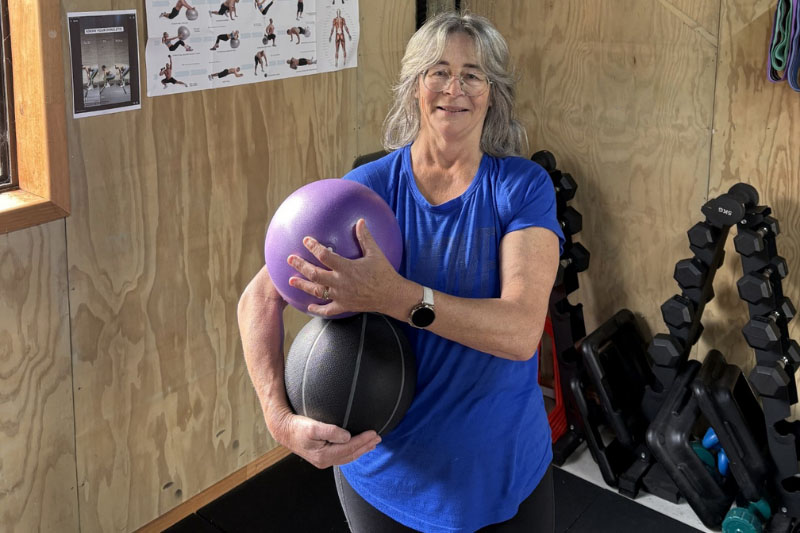
Ask Mads Moulds what she does and you get a phrase that captures the whole role: "We're the coach behind the coach."
It's an easy thing to miss. On a Saturday, all eyes are on the coach, reading the game, working the sideline. Almost no one is watching her. That's the gap Mads has spent more than fifteen years closing across Te Tai Tokerau, and she's doing it with the kind of momentum you don't expect from someone who happily tells you she's just turned 60. "I'm living my best life," she says, and there's no reason to doubt it.
Central to nowhere
Before any of the coaching, there was the farm. Mads and her husband Mike, married 38 years with three kids between them, have run a dairy farm in Ararua for more than three decades. "Central to nowhere," she calls it: draw a line between Whangārei, Dargaville and Wellsford, and she's smack in the middle.
She came to it honestly. Her own parents were share milkers who shifted constantly, and she counts eight primary schools before the whānau finally settled near Kaipara College, where, as it happens, Mike was the boy next door. School was for sport more than study. "I probably went to school to eat my lunch," she admits. It took a PE teacher, Yvonne "Hilty" Hilton, to spot the athlete in her and pull her into the game.
That upbringing left its mark. "Once you're into something, you're in it," she says, which is why she was always first to training, and it's the same staying power she brings to growing coaches now.
The hand up nobody else put up
Her move from coaching players to developing coaches happened almost by accident. Around 2009, a coach developer role was advertised through the Coach Force programme. Nobody applied. Mads, running the dairy farm at the time and hardly short of things to do, couldn't let it sit. "We can't let this opportunity pass us by," she remembers thinking. "It's a role that's new. I can create it to work for me."
So she gave it a go. That instinct, to spot the gap, put your hand up and build the thing that isn't there yet, has shaped everything since.
The distance nobody sees
Part of what makes the mahi hard is the simple size of the place. From the lower part of the region, it's a three hour drive just to reach Kaitāia. Plenty of coaches live an hour from their nearest centre. Getting alongside them, in person, regularly, is a genuine logistical puzzle.
But the bigger gap is feedback. Mads is quick to point out that umpires have coach developers on the sideline giving them real time pointers during the break or straight after a game. Coaches get almost none of that. "Our coaches aren't getting regular feedback on even how they're communicating with their players, or what they look like on the sideline."
Do you look like you're across the game, or do you look like a crazy person? Most of the time, she says, it's neither, you're just concentrating. But no one's ever told you, because no one's watching. That's the space she steps into.
Backing coaches first
Coaches, Mads says, are a competitive bunch. Turning up and telling them what to fix is a fast way to get the door shut. Her approach is the opposite. "I back them as a coach first. I've got their back, and here's an opportunity to grow and be your better self."
Underneath it sits a belief she returns to again and again: "You only know what you know from the experiences you've had." The coach who was screamed at will coach by screaming. The one who was asked good questions learns to ask them. Her job isn't to throw out what a coach already knows, because a lot of it still holds up. It's to show them there's another way, and to sit alongside them, tuakana-teina (a relationship that involves an older person guiding a younger person) style, while they find it.
Seeing the cogs turn
Ask what she's proud of and she doesn't reach for a trophy. She talks about a young coach she's working with now, one who came from a different coaching background and is genuinely open to learning. "I can see the cogs ticking over," she says. "They can see what they know is what they know, but also what they don't know now. And they're keen to learn." Watching someone shift from copying the coach they had into thinking for themselves, that's the win. That's the whole point of the role landing in real time.
Never a vanilla biscuit
For someone so focused on others, Mads is refreshingly herself. "We don't have to be vanilla biscuits," she laughs, a shot at the idea that coaches should flatten their personalities to fit a mould.
That comes through most when she talks about innovation. She loves a game that never stops changing. The lift, she points out, didn't arrive the day a couple of Silver Ferns tried it on the international stage. "I'd already been doing that with my college team." Coaches and players around the motu had been experimenting with it for years. "I love coaches to try new things, players to try new things. Be innovative."
She lives it, too. Semi-retired to a second block, she built her own gym, "The Madhouse," where she runs Pilates, HIIT and a hybrid "Madhouse Special" she designed herself. She calls the people who show up her team. High fives at the end. It's the same instinct that drives her coaching, to build a community people actually want to be part of, and keep it moving forward.
More of her
Ask about the future and the answer is all about legacy. "My whole goal is to retire having developed another coach developer, or three. I'd like way more of me out there supporting our coaches."
She points again to that umpire model, support people on the ground with feedback flowing regularly, and wants the same steady backing for coaches across the North. And she's clear about what makes it possible: a united Te Tai Tokerau. "That's the beginning of our pathway. It's the only way forward."
More coaches. More coach developers. A stronger North. And Mads, at 60, still building it, one hand up at a time.
Want to become a Coach Developer, or interested in connecting with one? Get in touch with your local centre for more information.